
Crack Filling Before Winter in Colorado Springs
Colorado freeze-thaw turns small asphalt cracks into potholes over one winter. Why crack filling runs later than seal coating, and when to book.
A crack is not a cosmetic problem. It is an opening straight down to the base, and in Colorado Springs it only takes one winter for that opening to turn into a pothole. Water runs into the crack, freezes overnight, expands about nine percent, and pries the crack wider every time it cycles. We run well over a hundred freeze-thaw cycles in a season here, so a hairline crack in September is commonly a quarter inch wide by April.
Once water gets past the asphalt and into the base, the damage stops being about the surface. Saturated base material loses strength, the pavement above it starts flexing under traffic, and the crack network spreads into alligator patterning. At that point you are buying saw-cut removal, base repair and patching — dollars per square foot instead of cents.
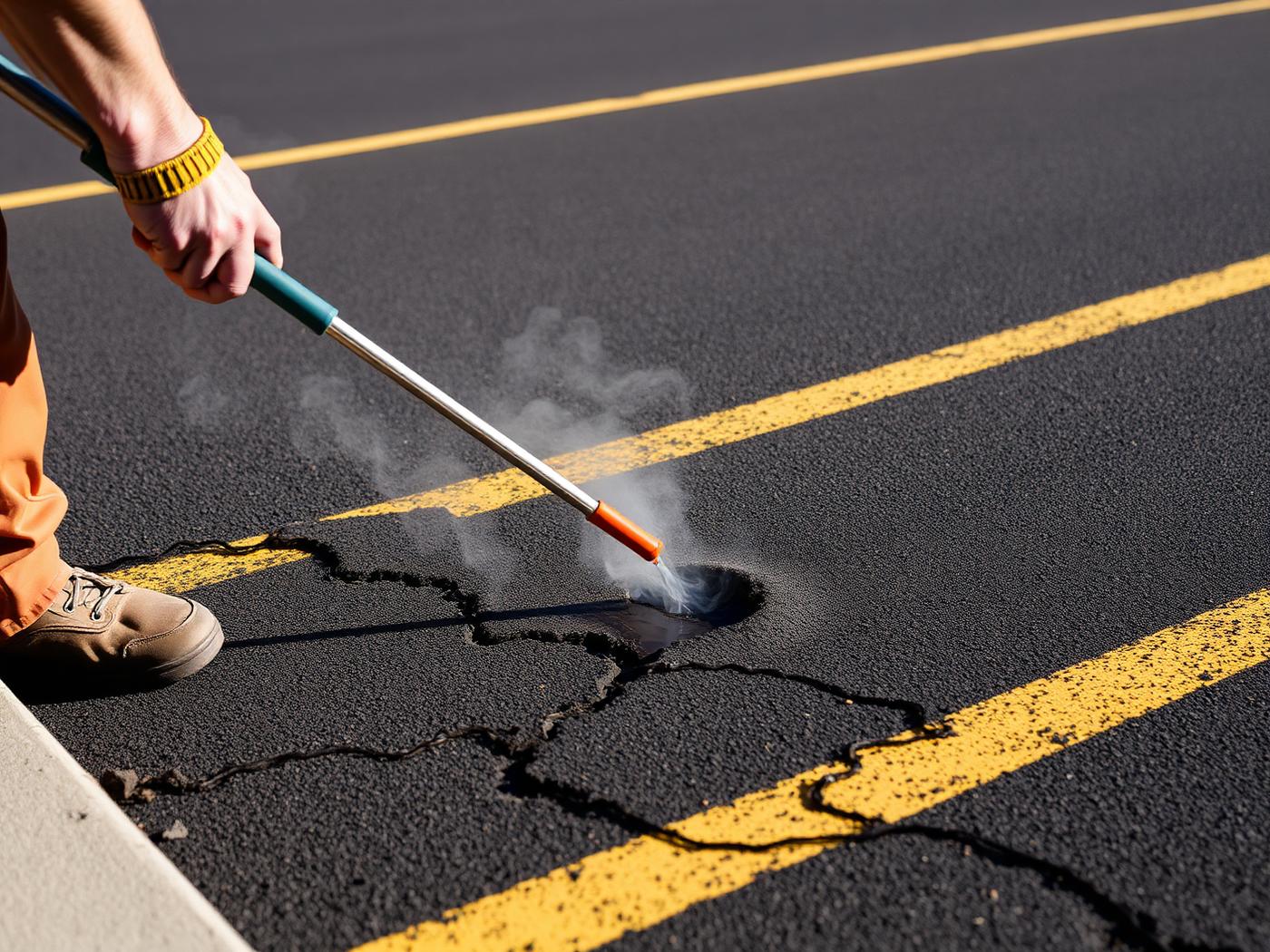
Hot tar crack filling is deliberately later in the season than seal coating, and that surprises people. Sealer is a thin emulsion coating that needs 50°F and rising plus a 24 to 48 hour cure, so it shuts down in early October. Hot-applied crack sealant goes down at several hundred degrees, and it bonds to the crack walls by heat rather than by ambient warmth. Cooler pavement is actually helpful: cracks are at their widest when the asphalt is contracted, so the material reaches deeper and you get a fuller fill. We routinely crack fill weeks after the last sealing day, as long as the cracks are clean and dry.
What crack filling does not do: it will not fix a section where the base has failed, it will not close alligator cracking, and it is not a substitute for sealer on a dry, gray surface. Cracks wide enough to drop a pencil into are ideal candidates. Anything spongy, rocking under a tire, or pumping water at the edges needs repair instead.
The right order on most properties is crack fill first, then seal coat over the top, then restripe. If you are late in the season and can only do one thing, do the crack filling. Sealer protects the surface from UV; crack filling keeps water out of the structure, and water is what actually destroys pavement over a Colorado winter.
When to book: get on the schedule in September so the work lands before the first hard freeze rather than after it. If you are unsure whether your driveway or lot needs crack filling, seal coating or repair, we will walk it with you and tell you straight. Free written estimates. Call (719) 233-6810.
Ready to pave or protect your lot?
Paving, chip seal, seal coating, crack filling and striping across Colorado — free written estimates.