
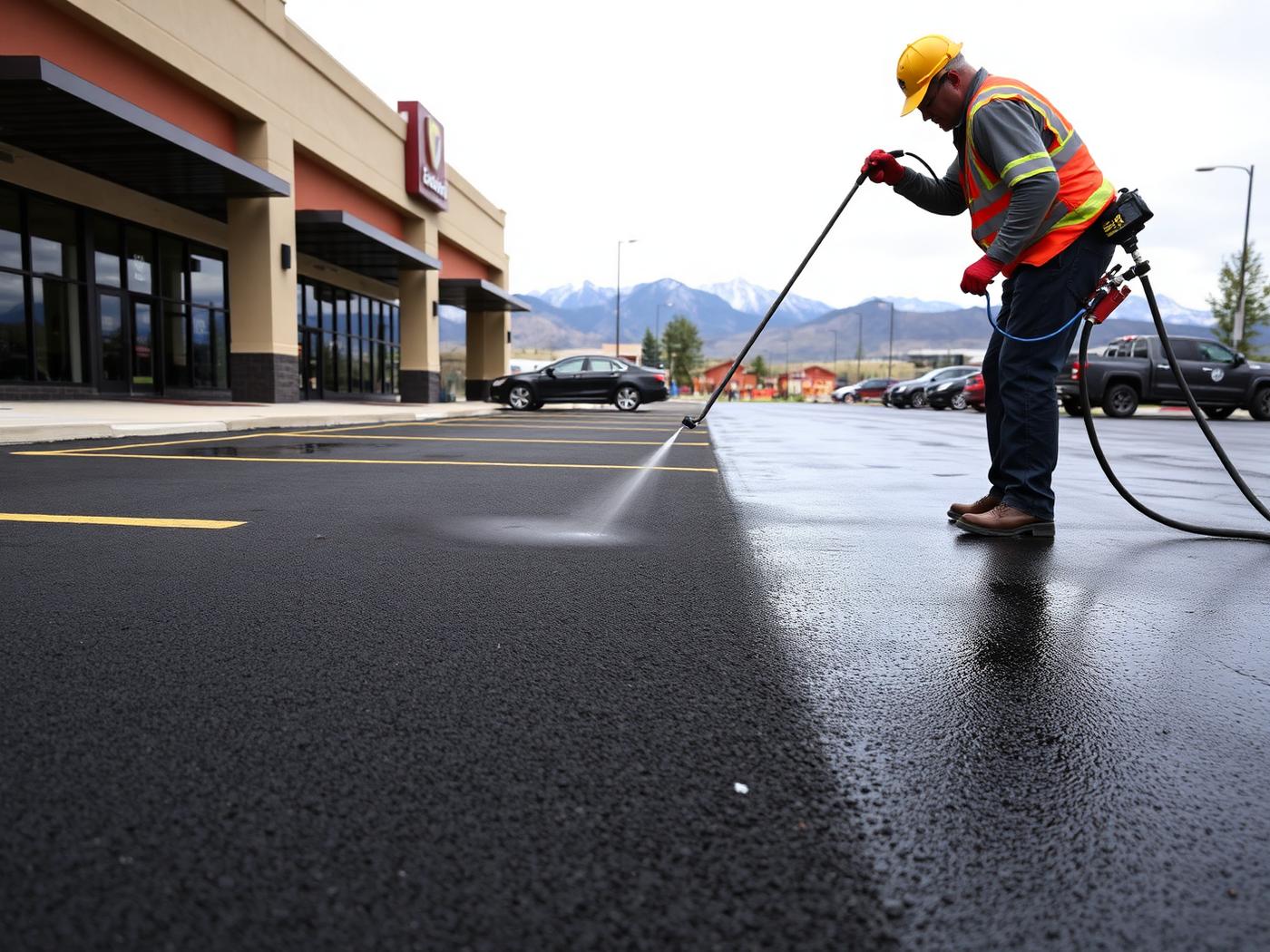
Last Call for Seal Coating Before Colorado Winter
Why sealer needs pavement and air temperature above a threshold to cure, what happens if it goes down too late, and when the window actually closes.
Every year we get calls in late October from people who want their driveway sealed before the snow. Most years we have to tell them it is too late, and explain why doing it anyway would be worse than not doing it at all.
Sealer has to cure, and curing needs heat
Seal coat is not paint. It goes on as a liquid emulsion and it has to cure, which means the water carrier evaporates and the material bonds to the asphalt underneath. That process needs warmth in the air and, more importantly, warmth in the pavement itself.
Pavement temperature lags air temperature by hours. A sunny fifty-degree afternoon in October can sit over asphalt that never got warm enough to take a coating properly, especially on a shaded drive or a north-facing lot.
What happens when it goes down too late
Sealer that does not fully cure stays soft. It tracks onto shoes and tires, it scuffs, and it picks up dirt into the surface instead of shedding it.
Worse, an uncured coating does not bond. The first freeze-thaw cycle gets underneath it and it starts lifting in sheets the following spring. At that point the driveway looks worse than if nothing had been done, and the old coating has to come off before a new one can go on.
The Colorado complication
Our elevation gives us wide daily temperature swings. A day can hit the mid-sixties and drop below freezing the same night. Air temperature at the moment of application tells you very little about what the surface will do eight hours later.
That swing is also what makes crack filling here so important. Water gets into a crack, freezes, expands, and levers the crack wider. Repeat that a few dozen times over a winter and a hairline crack becomes a structural one.
The right order
Crack filling first, then seal coat. Sealer bridges hairlines but it does not fill a real crack, and coating over an open crack seals in the water rather than keeping it out.
If time only allows one before winter, fill the cracks. That is the one that prevents damage. Seal coat protects the surface and can wait for spring.
When the window actually closes
It moves year to year with the weather, which is why we will not print a date and then tell you something different in the field. Broadly: seal coating wants to be finished well before consistent overnight freezes, and crack filling has a longer window because hot-applied material does not depend on ambient cure the same way.
Call and we will tell you honestly whether your pavement can still take a coating this year, or whether the right answer is crack filling now and seal coat in the spring. We would rather tell you to wait than sell you a coating that lifts.
See what our seal coating service in Colorado Springs includes, or if the sealing window has closed, our hot tar crack filling service runs later into the season.
Ready to pave or protect your lot?
Paving, chip seal, seal coating, crack filling and striping across Colorado — free written estimates.