
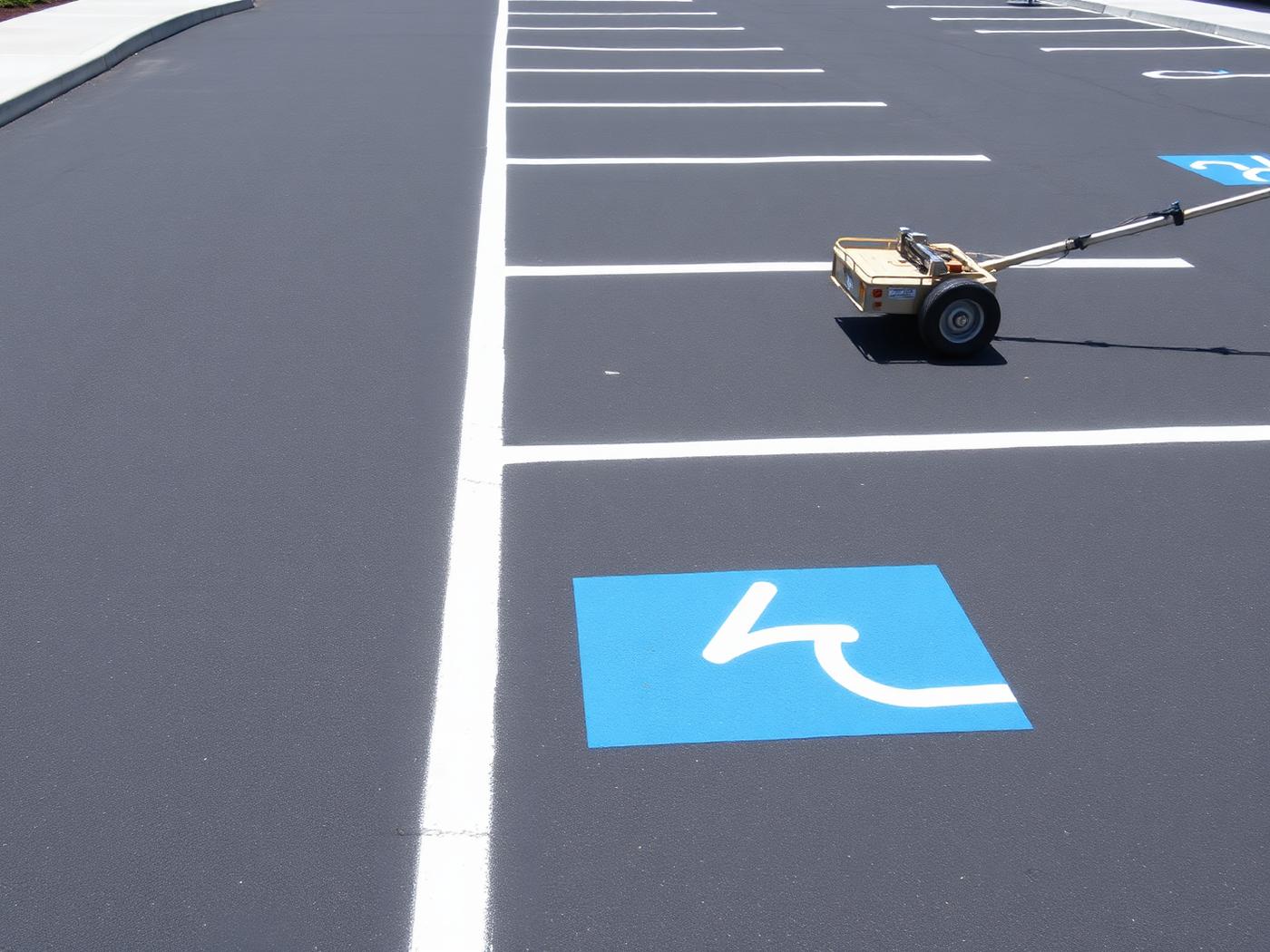
Parking Lot Striping and ADA Compliance in Colorado
Stall counts, accessible spaces, access aisles and signage. What a compliant lot actually needs and when restriping is due.
Striping looks like the simplest line item on a lot — paint on pavement. But it is the one part of your parking lot that carries legal requirements, and it is the first thing every customer sees when they pull in. Faded, crooked or non-compliant striping says something about a property before anyone walks through the door.
How many accessible spaces a lot needs
The number of accessible spaces scales with your total stall count. Small lots need at least one, and the requirement climbs as the lot grows, with van-accessible spaces required in the mix. This is not a guideline — it is federal law, and restriping is the moment most lots get brought back into compliance. If your lot was striped years ago and the layout has drifted, a restripe is the time to measure it against the current requirements, not just repaint what is there.
Access aisles and why nobody can park in them
The striped aisle next to an accessible space is not a no-parking zone for convenience — it is the space a wheelchair lift or ramp needs to deploy. An accessible space without a properly marked access aisle is not actually accessible, and enforcement treats it that way. Van spaces need wider aisles because side-entry lifts need the room. Cross-hatching has to be visible and continuous, which is exactly the paint that fades first.
Signage is part of the job
An accessible space is not compliant without its sign, mounted at the correct height and visible even when a vehicle is parked in the space. Signs that have faded, been knocked down or were never installed are as much of a gap as missing paint. When we stripe a lot we check the signage too, because paint without signs only does half the job.
Faded striping is a liability and a first impression
Beyond compliance, worn striping costs you in quieter ways. Drivers improvise when they cannot see stalls, which means door dings, blocked fire lanes and chaotic traffic flow. And a lot with crisp lines reads as a maintained property — the same way a faded one reads as neglect, fairly or not.
How often a Colorado lot needs restriping
Up here, paint fights two enemies: snowplows and high-altitude sun. Plow blades scrape lines physically, and UV at elevation breaks paint down faster than it does at sea level. A heavily plowed commercial lot will need fresh paint more often than a shaded low-traffic one. The honest answer is to walk your lot each spring after plow season and see what is actually left — if you have to squint to find the stalls, your customers already cannot see them.
The right order: repair, seal, then stripe
Striping is always the last step. Crack filling and patching come first, seal coating second, and paint goes down on the finished surface once the sealer has cured. Stripe first and seal over it, and you have paid for paint nobody will ever see. Sequence matters, and a contractor who offers to stripe before sealing is selling you the same lines twice.
Need a compliant layout or a full restripe? Free written estimates. Call (719) 233-6810.
See our parking lot striping service or our seal coating service.
Ready to pave or protect your lot?
Paving, chip seal, seal coating, crack filling and striping across Colorado — free written estimates.