
Pothole Repair vs Full-Depth Patching in Colorado Springs
When a pothole can be filled and when the whole section has to come out. What freeze-thaw does to a failed patch and why the cheap fix comes back.
Every pothole in Colorado Springs starts the same way. Water finds a crack, settles into the layers under the surface, and waits for a cold night. When it freezes it expands, and that expansion breaks the bond between the asphalt and the base underneath. Then traffic does the rest — every tire pumps a little more loose material out of the hole until you have a crater where a crack used to be.
That is why potholes here are not really a surface problem. They are a water problem that finally became visible. How we fix one depends entirely on what is happening underneath it.
The three ways a pothole gets fixed
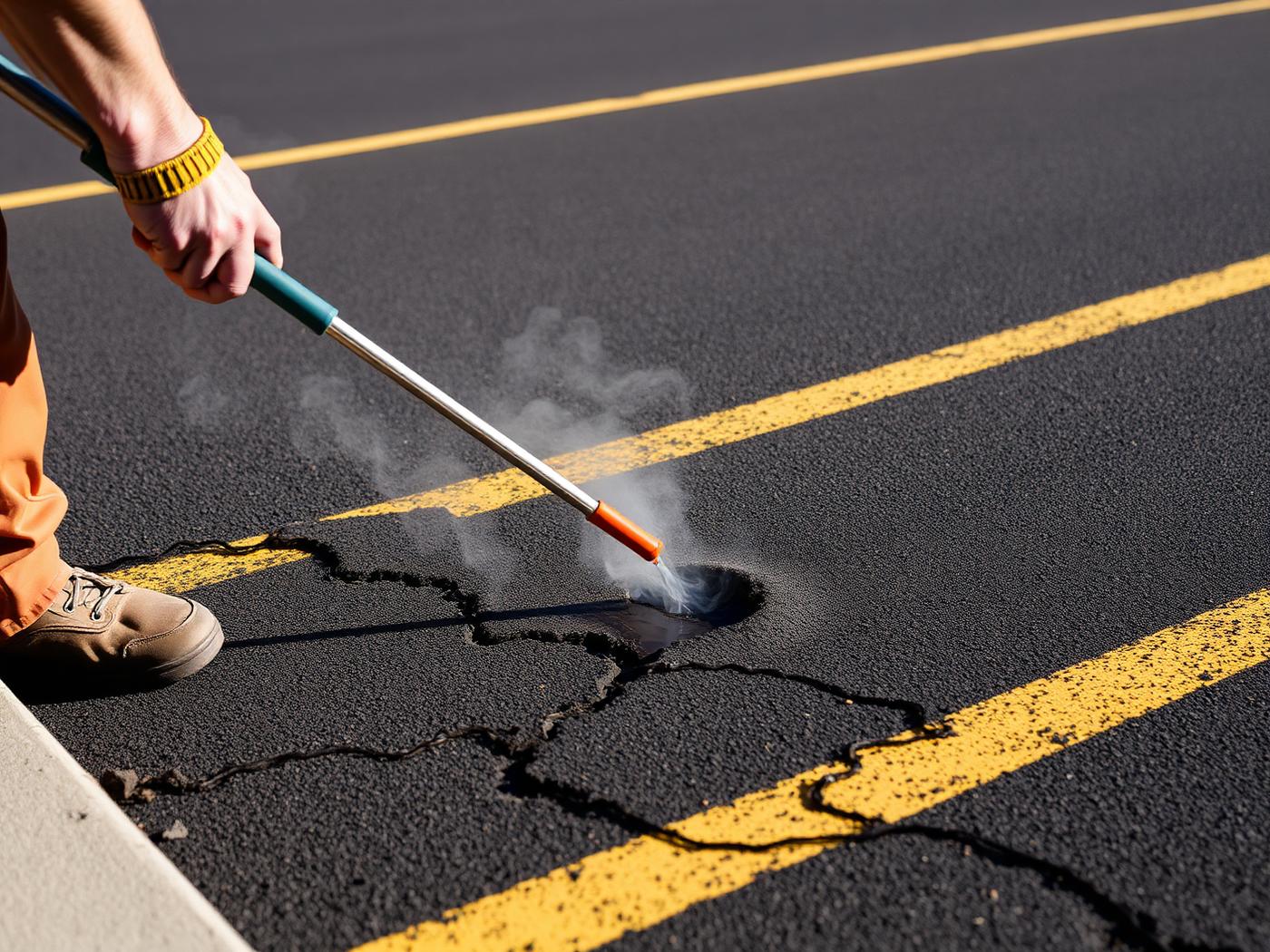
The cheapest option is a throw-and-go cold patch. Material gets dropped in the hole, compacted with whatever is on the truck, and traffic rolls over it the same day. It is a temporary measure and honest contractors treat it that way — it buys time in winter when hot mix plants are down, nothing more.
A proper hot mix repair cuts the damaged area back to clean, square edges, tacks the faces so new material bonds, fills with hot mix and compacts it in lifts. Done right, this holds for a long time — as long as the base under it is still sound.
Full-depth patching goes further. The asphalt comes out entirely, the failed base is excavated, rebuilt and compacted, and then new asphalt goes down over a foundation that can actually carry load. It costs more than a surface patch and it is the only option that works when the ground underneath has given up.
How to tell which one your pavement needs
You can read a pothole without any tools. Look at the edges first. If the asphalt around the hole is firm, with clean breaks and no crumbling, the failure is probably local and a hot mix patch will hold. If the edges are soft, raveling or surrounded by alligator cracking — that interconnected pattern that looks like scales — the base is moving and a surface patch is money thrown in a hole.
Then look at water. If the hole sits in a low spot where water stands after every storm, the pothole is a symptom of a drainage problem. Patch it without fixing where the water goes and you will be patching the same spot again.
When the same pothole keeps coming back
A patch that fails repeatedly in the same location is telling you something: the problem is not the surface, it is the base. Saturated sub-grade, a utility trench that was never compacted right, a downspout dumping water under the pavement — whatever the cause, the ground is moving and no surface material will survive it. That is the point where full-depth removal stops being the expensive option and starts being the only option.
Repair or overlay the whole lot
One pothole is a repair. A lot full of them is a decision. When failures are scattered and the pavement between them is sound, targeted patching makes sense. When the surface is cracked everywhere and patches outnumber original pavement, an overlay — or full replacement — usually costs less over the long run than an endless cycle of repair calls. We will walk it with you, tell you which situation you are actually in, and put it in writing either way.
Free written estimates across Colorado Springs and El Paso County. Call (719) 233-6810.
See our asphalt paving and repair service or our hot tar crack filling service.
Ready to pave or protect your lot?
Paving, chip seal, seal coating, crack filling and striping across Colorado — free written estimates.