
Recycled Asphalt Millings for a Winter Driveway: What They Do Well
Heading into winter on a mud-and-gravel driveway? How recycled asphalt millings handle snow, plows and freeze-thaw, and where they make sense.
If you are looking at another winter of mud, ruts and frozen washboard on a long gravel driveway, recycled asphalt millings are worth understanding before the snow flies. They handle Colorado winters better than gravel in almost every way that matters, and for rural driveways they are often the right surface, full stop.
What millings are, quickly
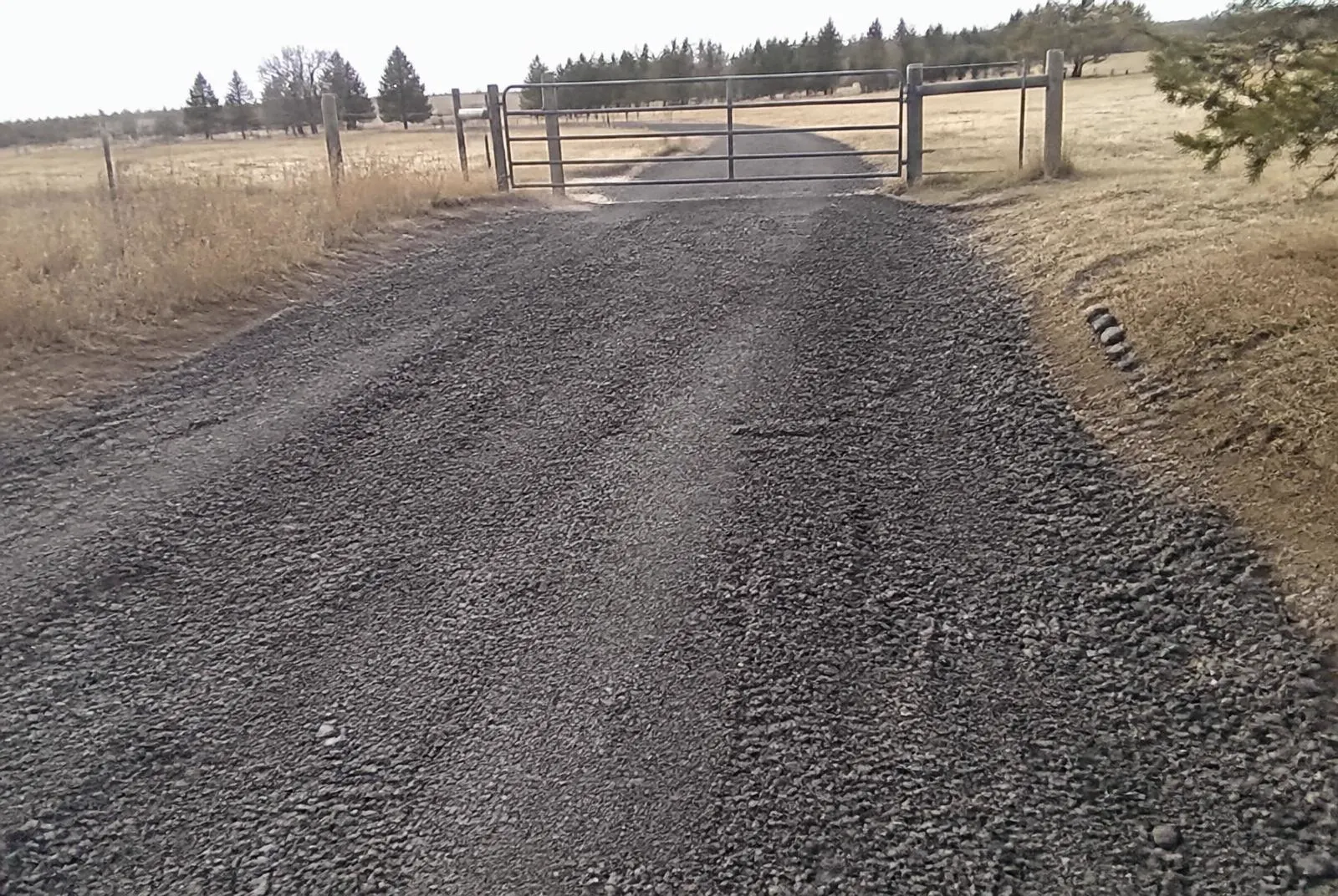
Recycled asphalt is old pavement ground up during road resurfacing. The material still carries its original binder, so once it is graded, compacted and kneaded by traffic and sun, it knits into a firm surface rather than staying loose rock. It looks like weathered asphalt and behaves like a middle ground between gravel and hot mix.
Why winter is where millings prove themselves
Gravel driveways fail in winter in predictable ways. Plows push the surface into the ditch. Freeze-thaw heaves it into ruts. Spring melt turns it to soup. Every spring you pay to re-grade material back onto the road that the winter pushed off it.
A compacted millings surface holds together through all of that. The bound fines do not migrate the way loose gravel does, the surface sheds water instead of absorbing it, and a plow passes over it cleanly instead of harvesting it. Owners in Falcon, Peyton and out toward Calhan tell us the same thing: the first winter is when they stopped thinking about the driveway at all.
Plowing a millings driveway
Millings plow well, with one adjustment: the blade should ride with a little clearance rather than scraping to the surface, especially in the first season while the surface is still tightening. An operator used to gravel will instinctively dig in — worth a conversation before the first storm.
The payoff is a surface you can actually keep clear. Packed snow on a firm millings drive behaves like packed snow on pavement, not like a plow full of your roadbed heading for the ditch.
Freeze-thaw and heave
No surface escapes Colorado freeze-thaw, but millings handle it gracefully. The material has enough flexibility to move slightly with frost rather than cracking, and because it sheds water instead of holding it, there is less moisture under the surface to freeze and heave in the first place.
The caveat is the same as every surface: drainage decides everything. Millings laid on a properly graded, crowned base with somewhere for water to go will ride out the winter. Millings dumped on a flat, soft, wet track will rut like anything else. The material is forgiving; the prep is not optional.
What it looks like after a winter
Fresh millings go down gray and slightly rough. Through a summer they darken and tighten; through a winter they prove the surface. By the following spring a well-installed millings driveway typically looks more like weathered asphalt than like anything gravel-adjacent, and it keeps firming up with traffic.
Where millings are the right call — and where they are not
Long rural driveways, ranch roads, acreage approaches, equipment yards and overflow parking are the sweet spot — anywhere you need a firm, dust-free, plowable, all-weather surface and hot mix is hard to justify over that distance.
They are not the right answer where you want a smooth, sealed, blacktop finish, where you plan to stripe, or where heavy point loads sit in one spot. For a suburban driveway in Colorado Springs where curb appeal leads, hot mix usually wins. For a quarter-mile of road east of town, the math usually runs the other way.
Getting it done before winter
Late-season installation is often still possible when paving no longer is, because millings do not depend on warm curing conditions the way hot mix and sealer do. If you want to stop fighting your driveway this winter, it is worth a call now rather than in the mud of April.
Maintenance through the cold months
One of the quiet advantages of millings is how little they ask of you in winter. There is no sealer to worry about, no paint to protect, and no surface treatment that a plow blade can strip. If a spot does loosen up — a corner where vehicles turn hard, a low area that held water — the fix is simple: rake material back into place, compact it, and let traffic finish the job. Compare that with a gravel road, where the spring ritual is hiring a grader to pull your roadbed back out of the ditches, or with a paved surface where a winter failure means a repair bill.
The one habit worth keeping is water management. Keep the ditches and culverts open so meltwater has somewhere to go, and do not let snow piles sit in the same low spot all season. The surface handles the rest.
What the first season teaches
Owners new to millings usually go through the same arc. The first few weeks they watch the surface nervously, waiting for it to behave like gravel. The first plow pass is the test — and when the road is still there afterward, unscraped and unrutted, the worry ends. By spring, when the neighbors are re-grading and re-rocking, the millings driveway is simply ready for another year. That is the real argument for the material: not that it is cheaper the day it goes down, but that it stops asking for money and attention every season after.
We install recycled asphalt driveways and ranch roads across eastern El Paso County, Elbert County and the Black Forest. Free written estimates — call (719) 233-6810.
See our recycled asphalt service or our dirt work and grading service.
Ready to pave or protect your lot?
Paving, chip seal, seal coating, crack filling and striping across Colorado — free written estimates.