
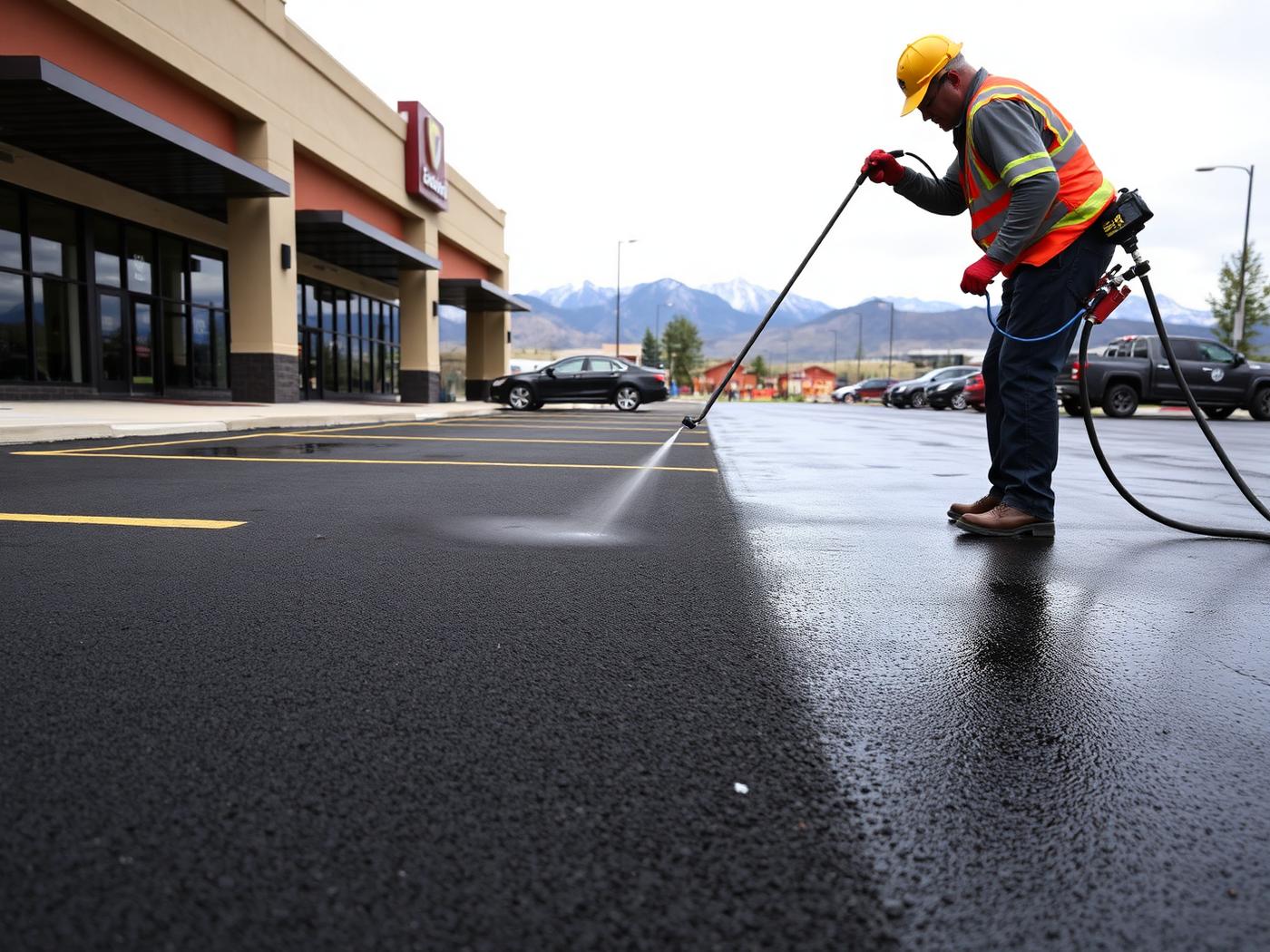
When to Seal Coat in Colorado Springs (And What Happens If You Wait)
Sealer needs 50°F and rising plus a 24–48 hour cure. At our elevation that window shuts in early October — here is what waiting until spring actually costs.
Seal coating is not a job you can do whenever it is convenient. Asphalt emulsion sealer needs surface and air temperatures of at least 50°F and rising, with no freeze in the forecast, and it needs 24 to 48 hours of that weather to cure hard. Put sealer down colder than that, or let it freeze overnight before it sets, and it never bonds — it stays soft, tracks under tires, and peels off in sheets the following spring.
At Colorado Springs elevation, that requirement is what closes the season in early October, not the calendar. We sit above 6,000 feet, so even on a 70°F afternoon the surface can drop below 40°F overnight. Once nightly lows settle into the 30s, the daytime window is too short for a full cure — and once we get the first hard freeze, the season is over regardless of how warm the following week looks. Practically, the last reliable sealing days are in the first half of October, and they book out fast.
What one winter does to unsealed asphalt: sealer is the only thing keeping UV off the binder and water out of the surface. Unprotected, the binder oxidizes, the surface goes gray and starts raveling loose aggregate, and every hairline crack becomes an opening. Water sits in that opening, freezes overnight, expands about nine percent, and pries the crack wider. Colorado Springs runs through more than a hundred of those freeze-thaw cycles in a single season. A crack you could barely see in September is commonly a quarter inch wide by April, and once water reaches the base and softens it, the pavement above it starts moving under traffic — that is the moment a maintenance problem turns into a repair problem.
The cost difference is not subtle. Seal coating and crack filling are square-foot maintenance items priced in cents. Once water has gotten into the base, you are buying patching, saw-cut removal and replacement, or an overlay — work priced in dollars per square foot, often an order of magnitude more for the same area. Spending on sealer and crack fill this fall is almost always cheaper than repairing one failed section next spring, and it protects the rest of the surface at the same time.
Which do you need first — seal coat or crack fill? Walk the lot and look at the openings. If the surface is gray and dry but the cracks are hairline and tight, seal coating is your job; sealer restores UV protection and closes the surface. If you have cracks wide enough to drop a pencil into, or long straight cracks running with the pavement edges, those need hot tar crack filling first — sealer bridges nothing and will simply sink into the gap. If you see alligator patterning across a whole area, spongy spots, or water pumping up at the edges under a tire, the base is already involved and neither product fixes it; that section needs repair.
The correct order on most properties is crack fill first, then seal coat over the top, then restripe. Done in that sequence you get one mobilization, a surface that is actually closed to water, and pavement that goes into winter protected instead of exposed.
If you are not sure which category your driveway or lot falls into, we will walk it with you and tell you straight — including if the honest answer is to wait until spring. Free written estimates. Call (719) 233-6810.
Ready to pave or protect your lot?
Paving, chip seal, seal coating, crack filling and striping across Colorado — free written estimates.