
Striping and ADA Compliance: Why Property Managers Cannot Wait for Spring
Faded striping and missing accessible markings are a liability every day, not just in paving season. What managers should check and fix before spring.
If your lot's striping is faded and you are planning to deal with it in spring, you are carrying a liability through the busiest retail season of the year. Compliance requirements do not pause for winter, and neither do the customers, inspectors and attorneys who notice missing accessible spaces.
Here is why the off-season is exactly when property managers should be looking at striping — and what can actually be done about it.
Compliance is not seasonal
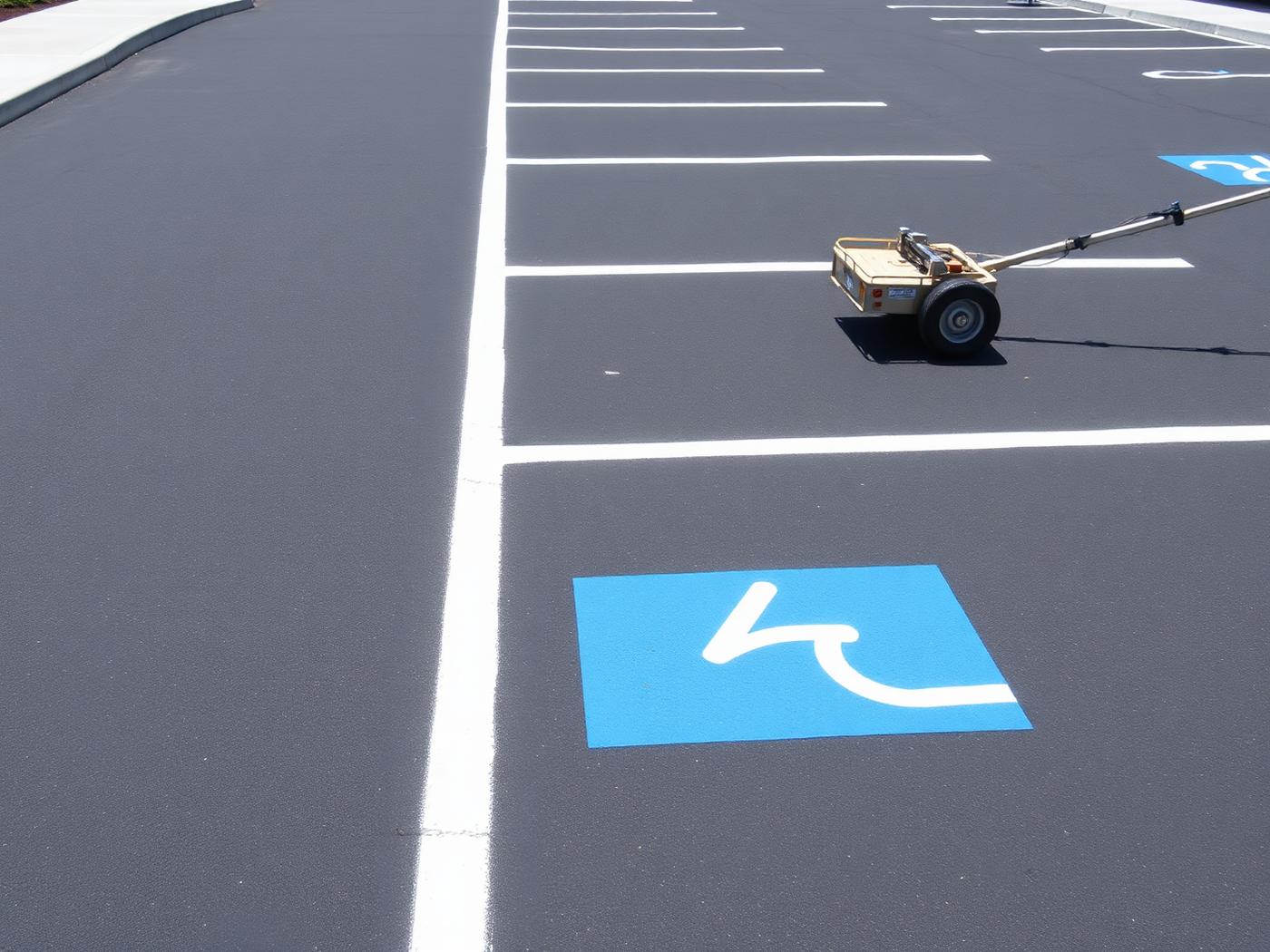
Accessible parking requirements apply every day your lot is open. A space whose markings have worn away, an access aisle that is no longer visible, a missing or faded sign — none of these get a pass because it is cold out. If someone cannot safely use your accessible parking in December, that is a December problem.
Winter actually makes it worse. Snow cover hides what markings remain, ice makes the walk from a distant space more dangerous, and holiday traffic puts more pressure on every stall you have.
What to check on your lot right now
Walk your accessible spaces first. Can you clearly see the stall markings and the access aisle hatching? Is the sign present, upright and visible? Is the route from the space to the building entrance passable and marked? If any answer is no, that is a gap that exists today, not in spring.
Then look at the rest of the lot. Fire lanes, no-parking zones, directional arrows, crosswalks — these are safety markings, and faded ones fail exactly when conditions are worst. A driver improvising in an unmarked lot on black ice is a claim waiting to happen.
The documentation habit
Even when full restriping has to wait for suitable conditions, the walk is worth doing now. Photograph everything, note the gaps, and get the work scoped and quoted so it is ready to schedule at the first window. Managers who do this in November get April dates. Managers who start in April get July.
Documentation also protects you. A dated record that you identified deficiencies and scheduled correction is a very different position than a faded lot with no evidence anyone looked at it.
Why faded striping costs you beyond compliance
Striping is the cheapest square footage of your property and the first thing customers see. A lot with crisp lines reads as a managed property; a lot with ghost lines reads as a neglected one, and tenants and customers draw conclusions accordingly.
There is also a traffic cost. Unmarked lots park inefficiently — drivers leave too much room, block lanes, and create conflicts that a layout would prevent. You effectively lose stalls you are paying to maintain.
The right sequence still applies
If your lot also needs crack filling, patching or seal coating, striping is still the last step — paint goes on a finished surface. That is another reason to plan now: the whole sequence can be scoped as one project, scheduled in the right order, and priced as a single scope instead of three emergency calls.
A note for multi-property managers
If you manage several lots, winter is when you walk all of them and rank them. Which properties have compliance gaps that cannot wait? Which need full restripes, which need layout corrections, which just need touch-up? A ranked list with photos turns spring into a scheduled program instead of a bidding scramble.
Layout drift is real
Lots change over the years without anyone deciding anything. A planter gets added, a dumpster corral moves, a tenant buildout shifts an entrance — and suddenly the striping that was compliant when it went down no longer matches how the lot is used. Accessible spaces end up on the wrong side of a slope, access aisles open onto new obstacles, and routes to the entrance cross traffic they never used to. A restripe that simply repaints the old layout preserves the drift. One that starts from the current requirements and the current site fixes it.
What a striping visit should include
A proper striping scope is more than paint. It should confirm stall counts and dimensions, verify the accessible spaces and aisles against current requirements, check signage presence and condition, and flag any surface repairs that need to happen before paint goes down. If a contractor measures nothing and just asks where the old lines are, you are buying a repaint, not a layout — and any compliance gaps in the old layout come with it.
The holiday-season reality
There is a practical reason to act before spring that has nothing to do with regulations: the months ahead are when your lot works hardest. Holiday retail traffic, winter weather, deliveries and snow operations all compress into the same stretch. That is when clear stall markings, visible crosswalks and unambiguous accessible spaces earn their keep — and when their absence generates the complaints, the near-misses and the door-ding disputes. A lot that is easy to navigate in a January snow flurry is a lot that was marked correctly before the snow arrived.
Getting it scoped now costs nothing
The walk, the photos, the layout review and the written quote are free. What they buy you is a clear picture of where your lot stands and a scheduled correction instead of a spring surprise. Even if the paint itself waits for suitable conditions, the decision does not have to.
We stripe and lay out lots across Colorado Springs, Castle Rock, Parker and the Front Range — accessible spaces, access aisles, signage checks, fire lanes and full restripes. Free written estimates — call (719) 233-6810.
See our parking lot striping service or our seal coating service.
Ready to pave or protect your lot?
Paving, chip seal, seal coating, crack filling and striping across Colorado — free written estimates.