
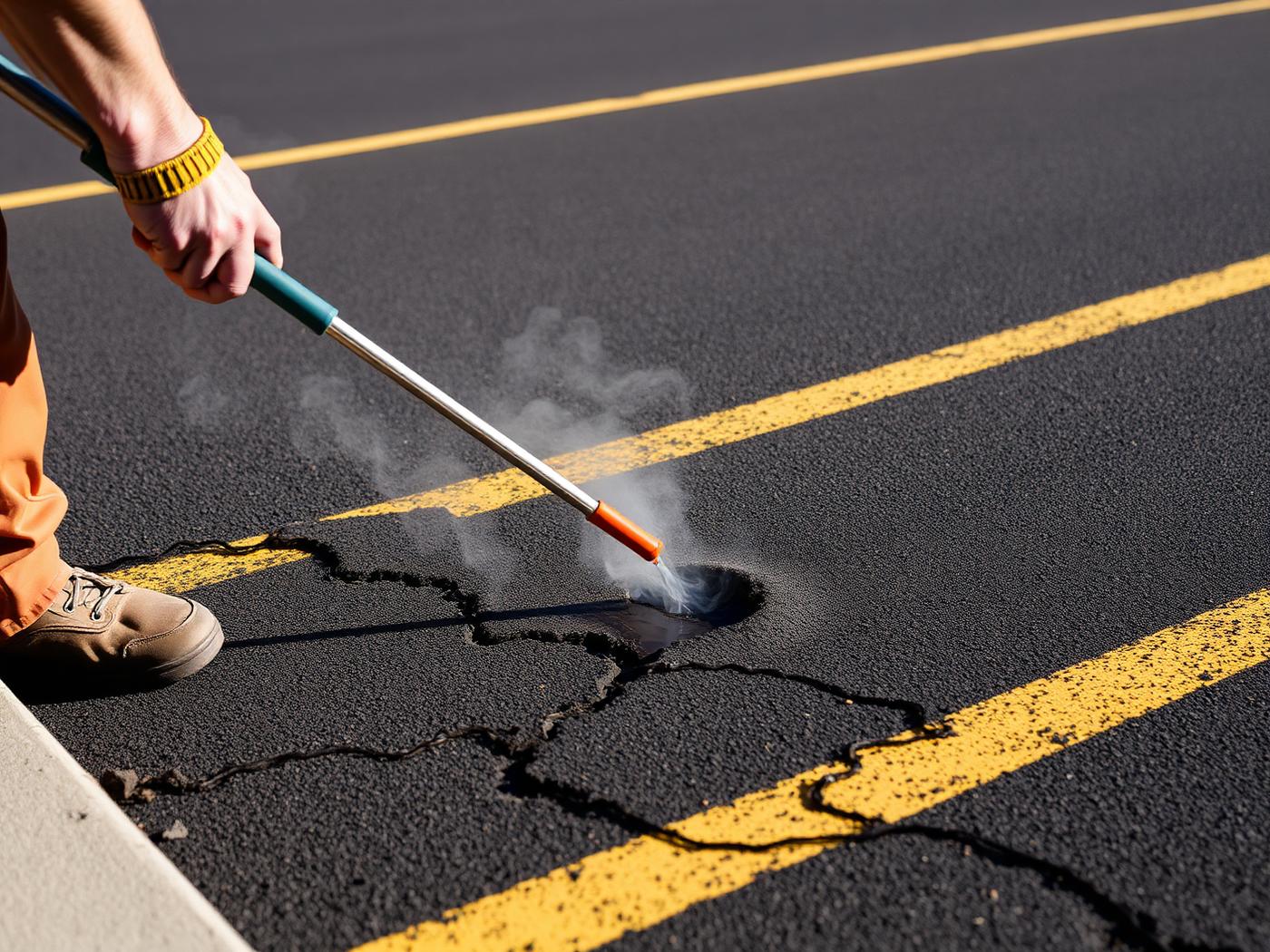
Why Water Under Asphalt Is the Real Enemy, Not the Cold
Cold gets the blame for wrecked Colorado pavement, but water does the damage. How water gets under asphalt, what it does there, and how to stop it.
People blame Colorado winters for destroying their pavement, but cold alone does very little to asphalt. The real enemy is water — water that gets under the surface, sits in the base, and then lets the cold do its work. Understand that one fact and every crack, pothole and heave on your property starts to make sense.
Asphalt handles cold fine. It does not handle wet.
Asphalt is a flexible pavement designed to move a little with temperature. Dry, well-drained pavement rides through decades of freeze-thaw with nothing more than surface aging. The failures you see — the potholes, the alligator cracking, the sections that drop and heave — almost all trace back to moisture where it should never have been.
The cold is just the lever. Water is the load.
How water gets underneath
The obvious route is open cracks. Rain and meltwater run across the surface, find every opening, and drain straight into the layers below. A hairline crack passes a surprising amount of water over a season, and a wide crack is a funnel.
The less obvious routes matter just as much. Edges where pavement meets grass or gravel let water in from the side. Failed joints between old and new pavement act like cracks. Low spots that pond water give it time to find every weakness. And downspouts or slopes that dump runoff onto or across pavement keep the whole system wet.
What water does once it is down there
The base under your asphalt is compacted aggregate and soil, and its strength depends entirely on staying compacted and reasonably dry. Saturate it and it softens. A soft base flexes under every vehicle, and the asphalt above it — which was never meant to span soft ground — cracks under the movement.
Then winter adds the multiplier. Water in the base freezes, expands, and lifts the pavement. It thaws, drains, and leaves a void. Traffic collapses the void. Repeat that cycle through a Colorado winter and a slightly soft spot becomes a failed section.
The freeze-thaw pump
There is a nastier version worth knowing about. When water-saturated base freezes and thaws under traffic, the movement can actually pump fine soil up through cracks, leaving progressively larger voids below. You see the evidence as staining around cracks and a surface that feels hollow or moves underfoot. By that stage the repair is no longer about the surface at all.
Why drainage beats repair every time
This is the part property owners find frustrating: the visible damage is never the actual problem. You can patch the pothole, overlay the cracked section, seal the surface — and if water is still getting into the base from the same source, the failure comes back, usually in the same place, usually bigger.
The fixes that actually last start with water. Regrade so runoff sheds off the pavement instead of onto it. Extend downspouts. Fill the cracks so the surface stops leaking. Cut out and rebuild the sections where the base is already gone. None of this is glamorous, but it is the difference between repairing once and repairing annually.
What to look for on your property
After the next rain or melt, walk your pavement. Where does water stand, and where does it run? Standing water marks the low spots that will fail first. Water running across the surface marks where it is finding cracks. Water running off a roof or slope onto the pavement marks a base that stays wetter than it should.
Also look for the telltales of existing base problems: alligator cracking, patches that keep failing in the same spot, edges that crumble, and any area that feels soft or springy under a vehicle.
The practical order of operations
Stop the water first — grading, drainage, downspouts. Seal the surface second — crack filling, then seal coating where appropriate. Repair the structure third — full-depth patches where the base has failed. Done in that order, repairs hold. Done in reverse, you are decorating a problem.
The shaded-side problem
One pattern we see constantly in this area: the shaded side of a property fails first. A north-facing drive, the side of the lot behind the building, the stretch under the pines in the Black Forest — these areas stay wet longer after every storm and every melt, and the base under them never fully dries between events. The pavement over a perpetually damp base ages faster, cracks earlier and heaves harder in winter. If one section of your pavement always seems to be the problem, check how much sun it gets and how long water lingers there. The answer usually explains the repair history.
Gutters, irrigation and other quiet contributors
Not all the water comes from the sky. Downspouts that discharge at the pavement edge, irrigation systems that overspray onto the lot, and hose bibs that leak all keep base material wet through seasons when it should be drying out. We have traced more than one recurring failure to a sprinkler head aimed at the same strip of asphalt every morning. Before assuming the pavement is at fault, spend a week noticing where water comes from — the source is sometimes a five-minute fix that ends a years-long repair cycle.
Not sure whether your pavement problem is surface or water? We walk properties across Colorado Springs, Monument and the Black Forest and tell you honestly which one you are looking at. Free written estimates — call (719) 233-6810.
See our dirt work and grading service or our hot tar crack filling service.
Ready to pave or protect your lot?
Paving, chip seal, seal coating, crack filling and striping across Colorado — free written estimates.