
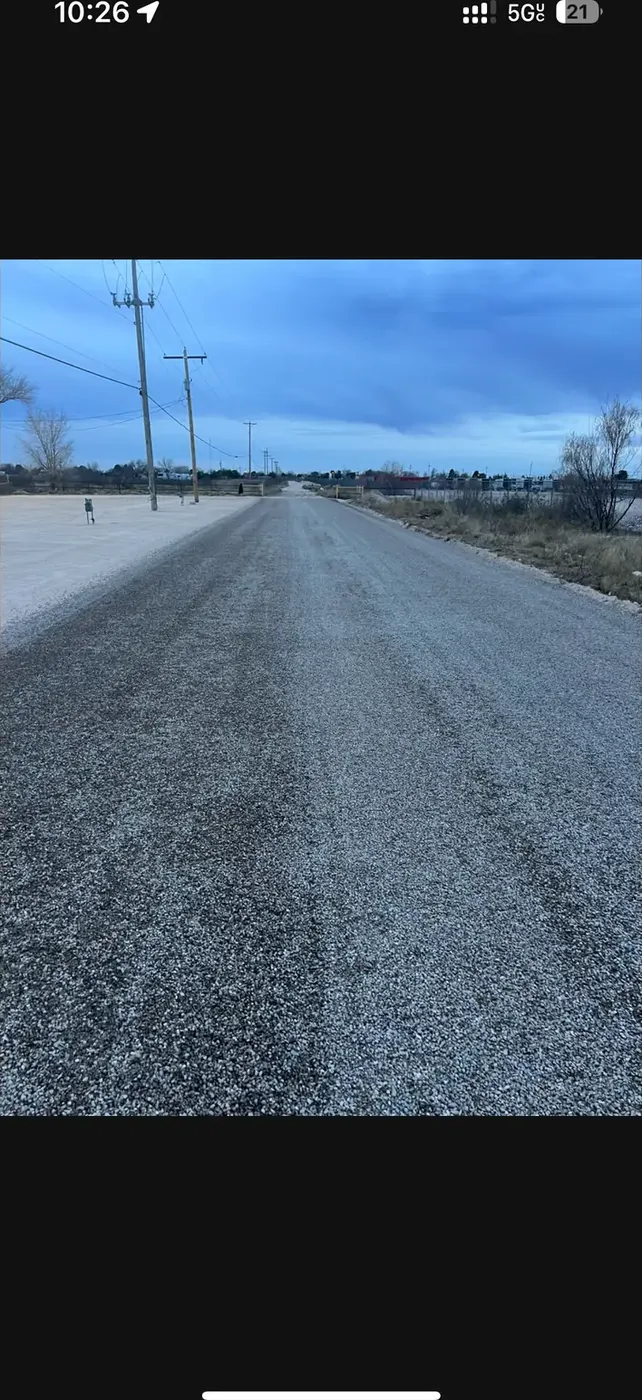
Chip Seal Paving
Chip seal surfacing for private roads, ranch driveways, HOA roads and low-traffic parking areas across Colorado Springs and El Paso County.
Binder, aggregate,
then rolled in tight.
Chip seal — also called chip and seal, tar and chip, or seal and chip — is a surface treatment rather than a poured mat of pavement. Instead of trucking in hot mix asphalt and laying it with a paver, a chip seal crew sprays a layer of hot asphalt binder directly onto a prepared surface and then covers that binder with a uniform layer of crushed stone. Rollers press the stone down into the binder while it is still tacky, and the two lock together into a single wearing course that sheds water, kills dust and gives you a firm, all-weather driving surface.
The job runs in three distinct steps, and each one has to be right for the surface to hold. First comes the binder. A distributor truck applies asphalt emulsion at a controlled, even spread across the width of the road. Too little and the stone never fully embeds; too much and the binder bleeds up through the chips. Second comes the aggregate. A chip spreader follows immediately behind the distributor, before the binder can set, and lays down crushed stone sized for the job — a smaller chip for driveways and parking areas where a smoother feel matters, a coarser chip where traction and durability on a longer road matter more. Third comes rolling. Rubber-tire rollers work the stone down into the binder so each chip is seated on its flat side and gripped from below.
After rolling, the surface needs traffic and sun to finish setting. The chips that did not seat stay loose on top until they are swept off, which is why the first stretch after a chip seal job looks and sounds different from finished pavement. Once the excess is swept and the binder has fully cured, what remains is a tight, dark, textured surface.
Some roads get a double chip seal: a second binder application with a second, usually finer, layer of aggregate on top of the first. That builds a thicker, tighter surface and is a common choice on long private roads and on any road carrying trucks, trailers, tractors or delivery vehicles.
Long roads, rural drives,
low-speed lots.
Chip seal earns its place where the surface area is large and the traffic is relatively light and slow. A quarter-mile ranch driveway, a shared access road serving a handful of homes, an HOA lane, or an overflow parking area all fit that description. Gravel on those roads washboards, dusts every dry week and migrates downhill with every storm. A full hot mix mat solves that, but paving thousands of feet of low-traffic road is a much larger project than most property owners need. Chip seal sits between the two: a real bound surface over the whole length rather than pavement over part of it.
It also works well as maintenance. An older asphalt road that is structurally sound but raveled, oxidized and losing its fines can take a chip seal as a new wearing course, which restores traction and seals the top against water.
Where chip seal is not the answer: high-speed roads, tight commercial lots with heavy turning traffic and dumpster pads, steep grades where studded tires and plow blades scrape hard, and anywhere the base is failing. If the ground moves, the surface moves with it.
Chip seal, paving
and seal coating.
Chip seal is binder plus stone, built in place. It creates a textured driving surface and protects what is underneath, but it is not a structural pavement layer.
Asphalt paving is hot mix delivered from a plant, laid with a paver and compacted into a smooth, continuous mat of a specified depth over a compacted base. That mat carries load. It is the right answer for busy commercial lots, city-facing driveways and anywhere a smooth surface is the point.
Seal coating is neither of those. It is a thin protective coating applied over existing asphalt to shield it from UV, water and oil. It adds no thickness and no strength — it protects a surface that is already there. A road that needs a new surface needs chip seal or paving; a sound lot that is drying out needs seal coating.
They also stack. Plenty of properties around Colorado Springs end up with a paved apron near the house or building, chip seal down the long stretch of drive, and hot tar crack filling on the paved sections as ongoing maintenance.
Freeze-thaw
and high-altitude sun.
Colorado Springs sits high, dry and sunny, and the surface temperature swing between a February afternoon and that same night is what breaks pavement here. Water finds a crack, freezes overnight, expands, and widens the crack. Repeat that through a winter and small defects become potholes. A chip seal surface has no long joints and no wide cracks to collect water in the first place, which is part of why it holds up on rural roads that see no plowing and little maintenance.
The high-altitude sun matters just as much. Ultraviolet exposure oxidizes asphalt binder, drying it out until the surface goes gray and starts shedding stone. Chip seal puts fresh binder and fresh aggregate on top, restoring the dark, flexible wearing course that the sun had cooked off.
Weather also controls the calendar. Binder needs warm pavement and warm air to wet the stone and set properly, and the surface needs sun and traffic afterward to finish embedding the chips. That makes chip seal a warm-season job in this region, not a late-fall one — which is worth knowing before winter closes the window on the work you were planning.
The surface under it
decides everything.
On a gravel or dirt road, prep means shaping the road: cutting and grading the surface, correcting the crown or cross-slope so water runs off instead of standing, clearing and re-establishing ditches and culverts where runoff has buried them, adding and blending base rock where the road has thinned, and compacting the whole thing. That dirt work and grading is not optional — a chip seal laid over a soft, unshaped road reproduces every dip and soft spot it was laid over.
On existing asphalt, prep means repairing failed areas, filling cracks, cutting out and patching any spot where the base has gone bad, and cleaning the surface so the binder bonds to pavement rather than to dirt. Vegetation along the edges gets cleared back so the new surface has a defined edge to hold.
Everything that is not getting surfaced gets protected before the distributor truck moves: concrete aprons, gutters, garage slabs, valve covers and mailbox bases. Binder is difficult to remove once it is on concrete, so covering comes before spraying.
What to expect
on the job.
Chip seal moves in a train: distributor truck, chip spreader, then rollers, with the aggregate going down before the binder sets. Because the pieces have to stay in sequence, we work in sections and keep traffic off the section being treated. On shared roads and HOA lanes we plan access and stage the sections with the property manager first so residents always have a way in and out.
Expect noise, equipment on the road, and the smell of hot asphalt while the crew is working. Once a section has been rolled, it can generally take slow traffic the same day unless we tell you otherwise on site.
The main thing to plan for afterward is loose aggregate. Not every chip embeds, and the excess sits on top until it is swept back. During that stretch, drive slowly, keep turns wide and avoid hard braking and spinning tires — sharp maneuvers on a new chip seal peel chips out and leave scuffs. Loose stone can also get thrown by tires, so slower speeds protect vehicles and windshields too. We come back to sweep the excess off, and the surface tightens as traffic and sun continue to set the remaining chips.
Once it has set, maintenance is simple: keep the ditches and drainage working, keep vegetation off the edges, and keep an eye on any spot that starts holding water. If you want a specific area looked at, we will come out and walk it with you and put an estimate in writing before anything starts.
Chip seal questions.
Chip seal in Colorado Springs?
Free written estimates on private roads, ranch driveways, HOA roads and parking areas.